



The aluminum foil glass wool blanket is one of the most common insulation products in metal building construction, and also one of the most misunderstood. Many buyers treat the foil as a cosmetic extra — a shiny surface that makes the product look more finished. In reality, the foil facing changes the physical function of the blanket in several measurable ways. Understanding what the foil does, and what it does not do, is the difference between specifying the right product and paying for performance you do not need — or skipping performance your building cannot do without. This article explains the technical advantages of the aluminum foil glass wool blanket in practical terms, and where those advantages genuinely apply.
What the Product Actually Is
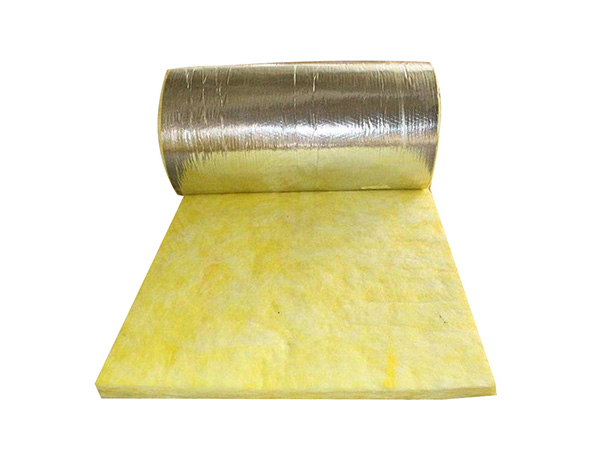
An aluminum foil glass wool blanket starts as a standard glass wool blanket — fine glass fibers bonded with a cured resin into a resilient mat with declared density and thermal conductivity. During production, a continuous aluminum foil (in some products a foil laminated to scrim or mesh reinforcement) is bonded to one face of the blanket. The finished product therefore combines two engineered components: the fiber core, which provides conductive thermal resistance, and the foil surface, which provides radiant reflection and vapor control. It is this combination that makes the product different from — and in metal buildings usually more effective than — an unfaced blanket of the same density and thickness.
Advantage One: Radiant Heat Reflection
Heat reaches a building in two forms: conducted heat and radiant heat. In summer, a metal roof absorbs solar radiation and re-emits it as long-wave radiant heat toward the interior. A significant share of the heat that makes an uninsulated steel building unbearable in summer is radiant heat, and conductive insulation alone cannot stop it — it can only slow the conduction that follows once surfaces heat up.
This is where the foil earns its keep. Bright aluminum surfaces have an emissivity in the region of 0.04–0.08 across the relevant infrared spectrum, and for an opaque surface, reflectivity is approximately the complement of emissivity. A low-emissivity foil therefore reflects the large majority of incident long-wave radiant heat back toward its source instead of absorbing and re-radiating it into the building. The practical effect: a foil-faced blanket delivers substantially better summer performance than the same thickness of unfaced blanket, because it interrupts the radiant mechanism that dominates heat gain in metal buildings. This advantage is largest where the foil faces an air space on the warm side — the classic configuration of a foil-faced blanket installed under a metal roof with the foil facing down into the building.
Advantage Two: Vapor Retardation
Aluminum foil is one of the most effective vapor-retarding materials available. When tested by the standard water-vapor transmission methods (for example ASTM E96), factory-laminated foil facings on insulation products typically report permeance values of 0.02 US perms or less — functionally a vapor barrier rather than merely a retarder. This property matters in metal buildings because of condensation physics: when warm, humid interior air reaches a cold metal surface, water vapor condenses on it. Rust, staining, dripping, and progressive corrosion of the structure follow.
The foil on the warm side of the aluminum foil glass wool blanket blocks the moisture path before it reaches the cold cladding, while the insulation thickness simultaneously keeps the cladding above the dew point of the interior air. The two mechanisms work together: the insulation reduces the temperature differential that drives condensation, and the foil removes the moisture supply. This is why foil-faced blanket is the standard specification for condensation control in unvented steel roof and wall assemblies — and why the foil's vapor-retarding function must not be defeated by unsealed laps, tears, or penetrations.
Advantage Three: Mechanical Protection of the Fiber Core
The foil facing is not only a thermal and moisture component; it is also a mechanical one. Unfaced glass wool is easily damaged during handling and installation — the surface fibers abrade, shed, and catch on obstructions, and the blanket edge can fray. The foil facing protects the fiber surface from this handling damage, keeps the blanket dimensionally intact through installation, and significantly reduces fiber release and skin irritation for installers working with the material. Products faced with reinforced foil (foil bonded to a scrim or glass mesh) add tear resistance, allowing the blanket to be fastened and supported over larger spans without ripping at the fixing points.
For installers, the practical consequence is a faster, cleaner installation with less waste. For building owners, the consequence is a finished insulation layer that survives the rest of the construction program — mechanical and electrical services are routinely run after insulation is installed, and a faced product tolerates incidental contact that would damage an unfaced blanket.
Advantage Four: A Cleaner, More Durable Interior Surface
In many metal buildings the insulation is the interior finish: there is no liner sheet, and the underside of the roof insulation is the visible ceiling. In this configuration the foil provides a bright, clean, reflective surface that improves interior lighting levels and presents a far more finished appearance than exposed fiber. The foil also sheds dust more readily than a fibrous surface, and it can be wiped down in service areas where hygiene matters. For agricultural buildings, workshops, warehouses, and showroom-quality industrial spaces, the visual and maintenance advantages of the foil face are often decisive in the specification, even before its thermal functions are considered.
When the Foil Advantage Is Real — and When It Is Not
The advantages above are conditional. The foil's radiant performance depends on a clean, unoxidized surface facing an air space; its vapor-retarding performance depends on continuous, sealed installation; and neither function replaces the need for correct insulation thickness. Three practical conditions deserve attention:
Foil facing must face the right side. As a radiant barrier and vapor retarder, the foil works on the warm side of the assembly — facing into the building in a heated building, facing the heat source in a hot-climate application. Installing the foil on the cold side defeats both functions.
Seams must be sealed. An open lap is a hole in the vapor retarder. Foil-faced blanket installations require lapped and taped joints at every seam and penetration for the vapor control to be real.
Fire behavior is a design consideration. Aluminum foil melts at roughly 660°C. In a fully developed fire the foil disappears, leaving the non-combustible fiber core — the fire classification of the faced product should be verified from the certificate for the exact product, and structural fire protection must never be assumed from an envelope insulation product.
Conversely, there are applications where foil facing adds cost without adding value: interior partitions that will be enclosed on both sides by liner sheets, applications where both faces must breathe, or assemblies where a separate vapor retarder is already part of the build-up. In those cases an unfaced or kraft-faced product is the economical choice.
How to Specify an Aluminum Foil Glass Wool Blanket
Specifying the product correctly means defining four parameters rather than ordering "foil-faced glass wool":
Core density and thickness — determined by the thermal and acoustic requirements of the assembly, not by the facing.
Foil type — plain foil, reinforced foil (scrim-backed), or foil with a white or colored decorative finish for exposed installations.
Facing position and width — single-face foil is standard; confirm the roll width matches the structural spacing to minimize cutting.
Standards and test evidence — the product should be manufactured and declared under the relevant specification (for example EN 13162, ASTM C553 or C665), with foil facing properties verified against standards such as ASTM C1136, and permeance data from ASTM E96 testing.
A manufacturer that can document all four parameters — and provide the corresponding test reports — gives the specifier what is actually needed: a product whose declared performance can be relied on in the assembly calculation.
FAQ
Q1: Is an aluminum foil glass wool blanket better than an unfaced blanket of the same thickness?
A: In metal building applications, usually yes — the foil adds radiant reflection and vapor retardation that unfaced blanket cannot provide. In assemblies where both faces are enclosed and a separate vapor retarder exists, the foil may add cost without benefit.
Q2: Which side of the foil faced blanket faces the interior?
A: In a heated building the foil faces the warm interior side — down into the building for a roof installation. As a radiant barrier it must face an air space, and as a vapor retarder it must sit on the warm side of the assembly. Confirm the orientation in the manufacturer's installation guidance.
Q3: Does the foil facing need to be sealed at the joints?
A: Yes. For the vapor-retarding function to work, laps and penetrations must be sealed with a compatible tape. An unsealed installation leaves open moisture paths that can cause localized condensation.
Q4: Does the aluminum foil affect the fire classification of the blanket?
A: The faced product must be tested as a complete system, and its classification certificate should cover the exact density, thickness, and facing. In a fully developed fire the foil melts, leaving the fiber core; envelope insulation should not be relied on for structural fire protection.
Q5: Can foil faced glass wool blanket be used where the interior surface must be washable?
A: Foil-faced products with a suitable surface finish are used in exposed installations where a cleanable interior surface is required, such as workshops and agricultural buildings. Confirm the product's surface specification and cleaning compatibility with the manufacturer.
Conclusion
The aluminum foil glass wool blanket is best understood not as glass wool with a decoration, but as a multi-function component: the fiber core delivers conductive thermal resistance, the foil delivers radiant reflection and vapor retardation, and the combined product delivers mechanical robustness and a serviceable interior surface. Those functions translate into real, measurable advantages in metal buildings — lower summer heat gain, reliable condensation control, faster and cleaner installation, and a durable finished interior — provided the product is specified with the right density, thickness, and foil type, installed with the foil on the correct side, and detailed with sealed joints. When those conditions are met, the foil facing pays for itself many times over in energy performance and building durability, which is why it remains the standard specification for steel roof and wall insulation across the industrial building sector. Specifiers comparing products can find the technical documentation — thermal, permeance, and fire data — on the pages of established aluminum foil glass wool blanket manufacturers before finalizing their specification.
References
1. EN 13162:2012+A1:2015, "Thermal Insulation Products for Buildings — Factory Made Mineral Wool (MW) Products — Specification," European Committee for Standardization, Brussels.
2. ASTM C553-13, "Standard Specification for Mineral Fiber Blanket Thermal Insulation for Commercial and Industrial Applications," ASTM International, West Conshohocken, PA.
3. ASTM C1136-17, "Standard Specification for Flexible, Low Permeance Vapor Retarders for Thermal Insulation," ASTM International, West Conshohocken, PA.
4. ASTM E96/E96M-16, "Standard Test Methods for Water Vapor Transmission of Materials," ASTM International, West Conshohocken, PA.
5. Jelle, B.P. (2011). "Traditional, state-of-the-art and future thermal building insulation materials." Energy and Buildings, 43(10), 2549-2563.