



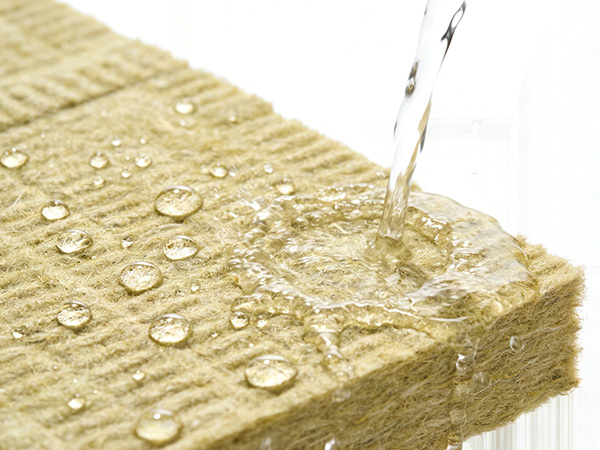
Dedicated hydrophobic rock wool board products take moisture resistance to a significantly higher level than standard rock wool through factory-applied water-repellent treatment that prevents liquid water penetration even under sustained exposure conditions. Hydrophobic rock wool board addresses the most challenging humid and wet environment applications where standard insulation products would fail prematurely, including marine vessels, offshore platforms, swimming pool plant rooms, wastewater treatment facilities, and coastal building installations.
How Hydrophobic Treatment Works
Hydrophobic treatment involves applying a silicone-based water-repellent compound to rock wool board products during manufacturing. The treatment coats individual fiber surfaces, reducing surface tension so that liquid water beads and is repelled rather than absorbed into the fibrous matrix.
Key performance characteristics of treated hydrophobic rock wool board: water absorption below 0.5 kg/m² under EN 1609 short-term partial immersion testing; water absorption below 1.0 kg/m² under EN 12087 long-term partial immersion testing; retained thermal conductivity after water immersion exceeding 90% of dry value; hydrophobic properties sustained throughout product service life without re-treatment.
Marine and Offshore Applications
Marine vessels, offshore platforms, and port infrastructure represent the most demanding application environment for hydrophobic rock wool board. Salt air, sea spray, wave impact, and condensation create continuous moisture exposure conditions that would rapidly degrade standard insulation.
Hydrophobic rock wool board is specified for ship hull and deck insulation where condensation on cold hull surfaces drips onto insulated structures; offshore platform accommodation and process module insulation where salt air, periodic wash-down procedures, and fire protection water deluge systems create extreme moisture exposure; and LNG carrier cargo tank insulation systems where cryogenic condensation could cause ice formation damaging the containment system. Hydrophobic rock wool board products used in marine applications must comply with IMO Fire Test Procedures code, SOLAS requirements, and classification society rules from DNV, Lloyd's Register, Bureau Veritas, or ABS.
Swimming Pool and Wet Process Facilities
Indoor swimming pool environments create continuously high relative humidity (60-80% RH) that condenses on cold surfaces and causes conventional insulation to absorb moisture, sag, and degrade. Hydrophobic rock wool board with appropriate vapor retarder and jacketing systems is specified for pool hall ceiling and wall insulation, pool plant room insulation around heat pumps and dehumidifiers, aquarium and water park building envelope insulation, and industrial laundries and wet process manufacturing facilities.
The hydrophobic rock wool board core prevents any liquid water that penetrates the jacketing system from being absorbed into the insulation, allowing the vapor retarder and jacketing systems to manage moisture vapor diffusion while the insulation core remains dry and thermally effective.
Coastal and Tropical Building Applications
Buildings in coastal environments experience elevated humidity, salt air, and occasional storm surge or wave impact exposure that tests insulation system durability. Hydrophobic rock wool board extends service life in coastal hotel and resort building envelope insulation, seawater cooling tower insulation, desalination plant insulation where brine leaks and salt spray are expected, and tropical climate buildings with intermittent heavy rainfall where roof insulation is at risk of moisture saturation.
Comparison with Alternative Wet-Environment Insulation
Hydrophobic rock wool board offers advantages over closed-cell foam alternatives in wet environment applications: non-combustibility (unlike closed-cell foam, it does not contribute to fire load or produce toxic gases when exposed to fire); thermal stability across wide temperature ranges from cryogenic to 650°C; and superior acoustic performance that closed-cell foams cannot match, eliminating the need for separate acoustic treatment.
Conclusion
Hydrophobic rock wool board products provide essential moisture protection for the most demanding humid and wet environment applications where standard insulation materials fail prematurely. Marine vessels, offshore platforms, swimming pool facilities, and coastal buildings all benefit from the superior water-repellent properties, retained thermal performance after moisture exposure, and non-combustible fire safety of hydrophobic rock wool board systems.
References
1. EN 1609:2013, "Thermal Insulating Products for Building Applications — Determination of Short-Term Water Absorption by Partial Immersion," European Committee for Standardization, Brussels, 2013.
2. EN 12087:2013, "Thermal Insulating Products for Building Applications — Determination of Long-Term Water Absorption by Immersion," European Committee for Standardization, Brussels, 2013.
3. IMO MSC.61(67), "International Code for Application of Fire Test Procedures," International Maritime Organization, London, 1998.
4. DNV Rules for Classification of Ships, Part 4, Chapter 8: Fire Protection, Detection and Extinction, DNV GL, Oslo, 2022.
5. Kumaran, M.K. (2019). "Moisture performance of hydrophobic mineral wool insulation in marine environments." Journal of Building Physics, 43(1), 55-73.