



Every kilogram of roof load must be supported by the structure below it, and every day added to the insulation installation program adds cost that the contractor cannot recover. When project teams evaluate lightweight roof insulation options, the comparison is rarely just about the material price per square meter. It is about the whole-system cost: what the insulation weighs, how fast it goes on, how much structural steel it saves, and what the finished building actually costs to operate. This article examines the roof insulation roll as a lightweight solution for steel buildings, explaining the technical basis for its dominance in industrial construction and the practical factors that determine whether it is the right choice for a given project.
The Weight Problem in Roof Insulation
Roof insulation materials vary dramatically in density, and that density difference translates directly into structural cost. A typical roof insulation roll in glass wool at 16–24 kg/m³ and 100 mm thickness weighs roughly 1.6–2.4 kg per square meter of roof area. A comparable insulation level in rigid mineral wool board at 120 kg/m³ and 60 mm thickness weighs roughly 7.2 kg/m² — three to four times as much. Expanded polystyrene at 15 kg/m³ achieves a similar insulation level by volume, but its combustibility creates fire safety constraints that often require additional protective measures.
For a 5,000 m² factory roof, the difference between 2 kg/m² and 7 kg/m² insulation is 25 tonnes of roof load. That additional load must be carried by the purlins, rafters, columns, and foundations — each structural element sized larger than it would need to be for a lighter insulation specification. The structural steel premium for this extra load can easily reach several dollars per square meter of roof area, which in a competitive market can exceed the material price difference between the insulation products being compared.
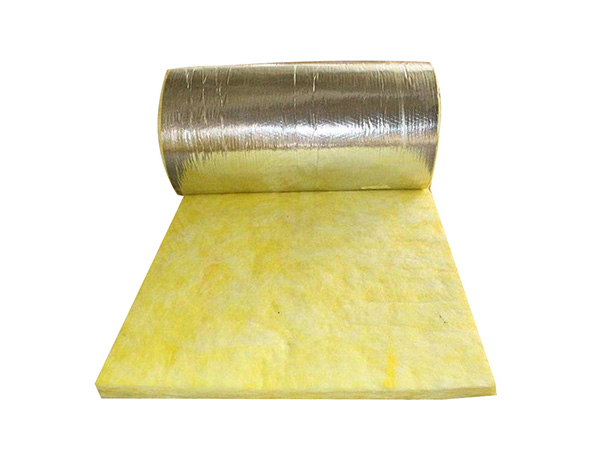
How Glass Wool Roof Insulation Roll Achieves Low Weight
The glass wool roof insulation roll achieves its low density through the physics of fibrous insulation. Molten glass is fiberized into fine filaments that trap air in a matrix of interlinked voids. The fiber itself is dense — glass has a specific gravity around 2.5 — but the fiber network occupies only a small fraction of the total volume, leaving the remainder as trapped air. The result is a material that is structurally mostly air, with a declared density in the range of 12–48 kg/m³ depending on the product grade.
This low density does not mean low performance. The air trapped between fibers is the actual insulating medium, and the fiber structure minimizes convective heat transfer within the mat. Declared thermal conductivity for glass wool products in this density range is typically 0.033–0.040 W/m·K, placing them in the same performance band as many higher-density alternatives. The insulation value comes from the air, not from the material — which is why a low-density roof insulation roll can match the thermal performance of a much heavier board product.
Installation Speed: What "Fast" Actually Means in Practice
Installation speed for roof insulation roll is measured in square meters per crew per day, and the factors that determine it are more specific than the general term "fast" implies:
Roll width matching structural spacing. When the roll width matches the purlin spacing, the blanket drops in without trimming. Standard widths cover common steel building geometries; custom widths are available for non-standard spacings.
Single-pass installation. A foil-faced glass wool roof insulation roll installs in one pass: the insulation goes down, the foil faces the interior, and the vapor retarder is in place. An unfaced product requires a separate vapor retarder sheet to be installed first, adding a step.
Light weight for manual handling. A 100 mm, 1,200 mm wide roll of glass wool blanket weighs approximately 10–15 kg — manageable by one person. Rigid boards of equivalent thermal performance weigh 30–50 kg per board, requiring two people or mechanical handling for every piece.
Fixing method simplicity. The blanket is pinned to the purlins or liner sheet with impaling pins and speed washers, or suspended on support wires. Both methods are fast and require no special equipment.
Under these conditions, installation rates of 400–600 m² per crew per day are achievable for roof insulation roll on standard steel roof geometries. On a 5,000 m² roof, this means a two-person crew can complete the insulation in roughly four to six working days — a schedule that rigid board products cannot approach without significantly larger crews or mechanical equipment.
How Weight Reduction Affects the Structural Steel Package
The structural implications of lightweight roof insulation are real but project-specific. In a simple portal-frame warehouse with a light roof cladding, the additional purlin load from a heavier insulation may be within the standard purlin capacity, meaning no structural premium is triggered. In taller or more complex structures where purlins are already working close to their design capacity, the same additional load may require upsizing to the next purlin section — adding cost that does not appear in the insulation budget but appears in the structural steel contract.
The connection between insulation weight and foundation design is more subtle and usually only significant in soils with low bearing capacity, or in seismic zones where the building mass affects the seismic demand calculation. In those cases, the insulation weight reduction from glass wool roof insulation roll can contribute to meaningful foundation cost savings, though this calculation is project-specific and requires a structural engineer to quantify.
Thermal Performance of Lightweight Glass Wool Roof Insulation
The thermal conductivity of a glass wool roof insulation roll at standard densities (12–24 kg/m³) is in the range of 0.035–0.038 W/m·K. For a temperate-climate industrial building, a 100 mm installation delivers a roof U-value in the region of 0.32–0.38 W/m²·K, which meets or approaches the requirements of most industrial building energy codes. Thicker installations (150–200 mm) reduce this to 0.20–0.28 W/m²·K for buildings with higher thermal performance targets or more extreme climate conditions.
The key point for specifiers is that the thermal performance of the lightweight roof insulation is not compromised by the low density — it is a consequence of the air trapped in the fiber structure. The thermal conductivity declared in the product datasheet is verified by testing per the applicable standard (EN 13162, ASTM C553, or GB/T 13350), and the value used in U-value calculations should be from that declared value, not estimated from density alone.
Fire Performance: Non-Combustible Without Additives
One of the practical advantages of glass wool as a lightweight roof insulation material is its inherent fire classification without the need for fire-retardant additives. Mineral fiber products manufactured without organic binders achieve A1 classification under EN 13501-1 purely from their mineral composition. For the building's fire strategy, this means the insulation does not add to the fire load and does not create additional hazards during construction or in service.
Standard glass wool products with low-phenol binder also achieve A1 or A2 classification depending on the product type and test conditions. Verify the exact classification for the specific product (density, thickness, facing) against the fire certificate, since the classification is not automatically transferred from one product variant to another.
When Lightweight Roof Insulation Is the Right Choice — and When It Is Not
Appropriate: Standard steel portal-frame buildings, warehouses, factories, and agricultural structures where roof slopes are moderate, the building is not highly humidity-controlled, and the primary performance targets are thermal efficiency, fire safety, and installation speed.
Requires attention: Cold storage and temperature-controlled facilities where vapor control is more demanding and thicker insulation may be needed. Consult the manufacturer's condensation risk assessment service for these applications.
Less appropriate: Applications where the insulation must be load-bearing (walkable roof decks, green roofs, ballasted systems), where the roof insulation roll format cannot provide the necessary compressive strength and alternative products are required.
FAQ
Q1: How much faster does a glass wool roof insulation roll install compared to rigid board?
A: Installation rates for glass wool roof insulation roll reach 400–600 m² per crew per day on standard steel roof geometries — approximately 2–3 times faster than rigid board alternatives, depending on crew size and roof complexity.
Q2: Does lightweight roof insulation sacrifice thermal performance?
A: No. Glass wool roof insulation roll achieves thermal conductivity of 0.033–0.040 W/m·K at standard densities, equivalent to or better than many higher-density alternatives. The thermal value comes from trapped air in the fiber structure, not from material mass.
Q3: Can lightweight roof insulation be used in buildings with high humidity?
A: Yes, with foil-facing on the warm side of the assembly. The foil provides vapor retardation, and the thickness raises the cladding temperature above dew point. For demanding humidity conditions, request a condensation risk assessment from the manufacturer.
Q4: Does the lightweight roof insulation reduce structural steel costs?
A: Potentially. The insulation weight reduction from glass wool (typically 1.6–2.4 kg/m² for a 100 mm installation) versus heavier alternatives can reduce purlin sizing requirements in buildings where the roof load is a significant design driver. The specific saving is project-dependent.
Q5: What roll widths are available for roof insulation roll?
A: Standard widths are produced in common purlin spacing increments. Custom widths can be produced for non-standard spacings. Confirm available widths with the manufacturer before specifying, and check that the width matches your structural geometry to minimize cutting on site.
Conclusion
The lightweight roof insulation case for glass wool roof insulation roll is not primarily about the material price — it is about the system-level economics of steel building construction. Low weight reduces structural steel requirements and enables installation speeds that rigid products cannot match. Thermal performance is not compromised by the density; it is delivered through the physics of trapped air in the fiber matrix. Fire safety is inherent to the material composition rather than added through chemical treatment. For project teams building or specifying steel roof structures, starting the insulation evaluation with lightweight roof insulation options — and confirming the specification with the manufacturer's technical service — is the practical path to a building that performs well, installs on schedule, and costs less to build than the alternatives. Technical documentation, U-value calculators, and installation guidance for roof insulation roll products is available from established manufacturers such as huashuoinsulation.com before the specification is finalized.
References
1. EN 13162:2012+A1:2015, "Thermal Insulation Products for Buildings — Factory Made Mineral Wool (MW) Products — Specification," European Committee for Standardization, Brussels.
2. ISO 6946:2017, "Building Components and Building Elements — Thermal Resistance and Thermal Transmittance — Calculation Methods," International Organization for Standardization, Geneva.
3. EN 13501-1:2018, "Fire Classification of Construction Products and Building Elements — Part 1: Classification Using Data from Reaction to Fire Tests," European Committee for Standardization, Brussels.
4. ASTM C553-13, "Standard Specification for Mineral Fiber Blanket Thermal Insulation for Commercial and Industrial Applications," ASTM International, West Conshohocken, PA.
5. Jelle, B.P. (2011). "Traditional, state-of-the-art and future thermal building insulation materials." Energy and Buildings, 43(10), 2549-2563.